
GLOBAL CENTRE STAGE
Mideast Peace Talks
Chance for Peace or Just Talk?
By Dr Richard L Benkin
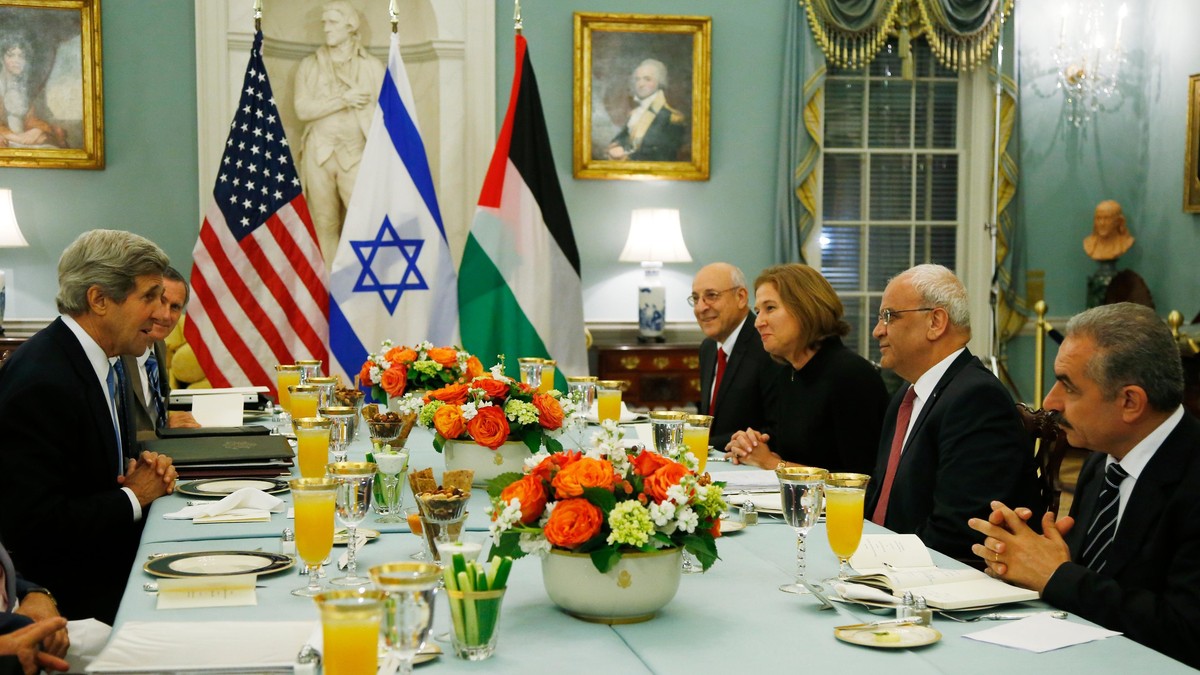
Will the eleventh major set of Middle East Peace talks since 1991
make the conflict more intractable or bring the region closer to peace
than it was before the first? Will they ratify the status quo rather
than changing it?
In October 2011, I posed the following to a panel of Middle East experts
and diplomats in Chicago: �A peace process is only relevant if it
leads to peace and not a mere cessation of hostilities � and I can tell
you from first-hand experience that the signs do not point toward peace.
Given the fact that by your own admission, you have been at this for a
generation � and where has that brought us � and that the definition of
insanity is doing the same thing over and over again expecting different
results, do you think it is time to scrap the very notion of a peace
process and instead focus on pragmatic options that parties can take
that would qualify them at some point to engage in a real peace
process?�
The panel uncomfortably avoided answering � understandably. The
question challenged their ideological and career commitment to a failed
process and demanded creative thought over knee-jerk, politically-driven
reactions. Middle East Peace talks, like those set to begin, make the
conflict more intractable, not less. They ratify the status quo rather
than changing it.
Expectations from Eleventh Peace Talks
This will be the eleventh major set of talks since 1991, and the region
is no closer to peace than it was before the first. US Secretary of
State John Kerry, who is driving the effort, said the parties �� can
make peace for one simple reason: because they must.� Middle East
expert David Ignatius, who favours the talks, calls that the key element
in Kerry�s strategy; but it was not enough in the past and is still not
enough. The core differences separating the two sides have not
changed. These talks are likely to end in one of the following,
all-too-familiar ways: The Palestinians will break them off.
There will be a statement about �progress� and future talks at some
unspecified date; answers to questions about what that progress is will
be insubstantial.
There will be a face-saving �agreement� that leaves core issues unresolved and the Middle East no closer to peace.
Talks with no agreement are worse than no talks because they emphasise
the gulf that separates the parties and the difficulty of bridging it.
The only outcome worse than no peace agreement is a bad one: one that
forces the parties to sign documents without resolving the issues that
led to war or that contain untenable conditions. The Treaty of
Versailles that ended World War I, for example, imposed draconian
conditions on Germany in an effort by external powers to remake and
punish that nation; its results were Adolf Hitler and World War II.
Pakistan�s 2009 peace agreement ceding the Swat Valley to the Taliban
brought ethnic cleansing to Hindus and oppression to women, but not
peace. Worse, despite initial western statements of �shock,� it became
the template for US President Barak Obama�s current negotiations with
Afghan Taliban and his curious search for �moderate Taliban.�
Can Peace Reign Supreme?
People who believe the Mideast conflict is about real estate, miss the
point. In a true peace agreement, the parties accept each other�s
states fully, end the strife between them, and relinquish all further
claims on territory and individual property. A two-state solution might
be part of any final agreement, but it is not its sine qua non. If a
Palestinian state on the West Bank and Gaza Strip with Jerusalem as its
capital was really what the Arabs wanted, they could have had one any
time before June 1967. Prior to Israel�s Six-Day War victory that year,
Egypt controlled Gaza, and Jordan controlled eastern Jerusalem and the
West Bank. It even gave us the name, West Bank; the historical names
are Judea and Samaria. The Palestinian Liberation Organisation, which
later morphed into the Palestinian Authority, formed in 1964 when Egypt
and Jordan � not Israel � were the occupying powers. Yet the group�s
charter called for Israel�s destruction and did not appeal to either
Arab state. It did not even mention Jerusalem. Palestinians could have
had even more by accepting the UN�s 1947 Partition Plan as Israelis
did; they did not. That was also before there were Arab or Jewish
refugees in the region. Imagine the loss of life that could have been
avoided if this is really what Palestinians wanted. Imagine where both
states and peoples would be now if they spent the last six decades on
development. Palestinians never demanded a state on the West Bank or
Gaza Strip until Arabs realised that their decades-old demands for
Israel�s destruction would never win them support among the wealthy and
influential Western powers.
I was in Israel during the 2000 Camp David talks. There was a great
deal of outcry over what then Prime Minister Ehud Barak was willing to
cede. Opponents were giving out leaflets on street corners and road
intersections, declaring �Barak is a traitor to the nation.� Yet, at
the same time, there was a quiet understanding that if Barak and Arafat
signed the agreement, the Knesset (Israeli Parliament) would ratify it,
and the nation would enforce it. And that is the key to peace.
Negotiations mean that the end is not pre-determined before they begin;
it means that both parties will leave the table with less than they
want; it means that they pledge to enforce all tenets. Defining borders
and territory is not the issue; people pretty much know what that will
look like. Even the issue of Jerusalem, while more complicated, is not
without multiple formulae for resolution. Settlements? They never
stopped peace talks until Obama declared them obstacles. Access to holy
sites, the status of refugees, water; none of these issues defy
resolution as long as there are two parties willing to negotiate and
live with the results; and for the past six decades, Israel has been the
only party prepared to do that.
The flagship article for the pro-Palestinian version of what happened at
Camp David notes that current Palestinian leader, Mahmoud Abbas �� made
clear to the Americans that the Palestinian side is unable to make
concessions on anything.� As the 2010 talks began, he said, �If they
(Israelis) demand concessions on the rights of the refugees or the 1967
borders, I will quit. I can�t allow myself to make even one concession.�
Nor is the problem a �right-wing� Netanyahu government in Israel. There
was international hand wringing when Israel elected its first Likud
Prime Minister, Menachem Begin; and it was he who ceded the entire Sinai
and made peace with Egypt. Similarly, former Prime Minister Ariel
Sharon, vilified as a �butcher� by the same crowd, unilaterally handed
Gaza to the Arabs. Netanyahu has gotten his coalition allies to cross
numerous red lines: releasing terrorists with blood on their hands,
freezing settlement construction, and accepting a Palestinian State.
Abbas has acknowledged that Netanyahu�s liberal predecessor, Ehud
Olmert, proposed a Palestinian state on 97 percent of the West Bank,
accepted the principle of the right of return of Palestinian refugees,
and offered to resettle thousands in Israel. Abbas turned it down saying
�the gaps were wide.� It is almost impossible to imagine any Israeli
government going further.
William B Quandt knows what a peace agreement looks like. He helped
broker the Israel-Egypt peace treaty that has survived major upheavals
for over 30 years. On current efforts he wrote, the US �� has provided
both a sense of direction and a mechanism. That, at its best, is what
the peace process has been about. At worst, it has been little more than
a slogan used to mask the marking of time.�
Even if the parties signed an agreement, would Arabs enforce it when
rejectionists like Hamas violate it? In 1994, Baruch Goldstein walked
into a mosque, opened fire, and killed 29 worshipers before the
survivors killed him. The Israeli government condemned the massacre,
arrested others with similar positions, and forbade certain settlers
from entering Arab towns. Jews and Jewish leaders worldwide condemned
Goldstein unequivocally; the Israeli Prime Minister described the act as
�loathsome.� Five years later, when some people made a shrine out of
Goldstein�s gravesite, the Israeli army dismantled it. No one watered
down their criticism by saying we should �understand� Goldstein�s anger;
or by generally condemning all terrorists. Criticism was unequivocal
and specific.
In contrast, the Palestinian Authority and all its agencies glorify Arab
terrorists, build monuments; and continue to do so as talks are about
to begin. Its schoolbooks teach children that their goal is all of
Israel, and their media and leaders congratulate terrorists like Samir
Kuntar whose �heroism� included killing a four-year old girl with a
rifle butt. That sort of thing makes it hard for me � as a Jew and a
human rights activist � to walk in Palestinians� shoes. If they stopped
referring to my people as apes and pigs, celebrating terrorists like
Kuntar, and denying our rights to live in our ancestral land; empathy
might be possible; and that would have a chance of bringing peace.
Editor�s note: Since Dr Benkin wrote this article,
Palestinians have broken off the peace talks. Despite denials from US
Secretary of State Kerry�s office, the Palestinian decision was widely
reported and confirmed by Palestinian spokespersons, one of whom also
said that the talks had gotten off to a �rocky start,� with the two
sides unable even to agree on an agenda. It is not clear at this point
if the Palestinian pullout is permanent halt or a temporary protest.
The action indicates frailty of the talks and the lack of commitment to
see them through to an agreement.
Go to Content Page
Dr Richard L Benkin is a
Chicago-based human rights activist. His latest book is A Quiet Case of
Ethnic Cleansing: The Murder of Bangladesh�s Hindus. Visit his website
http://www.Interfaithstrength.com