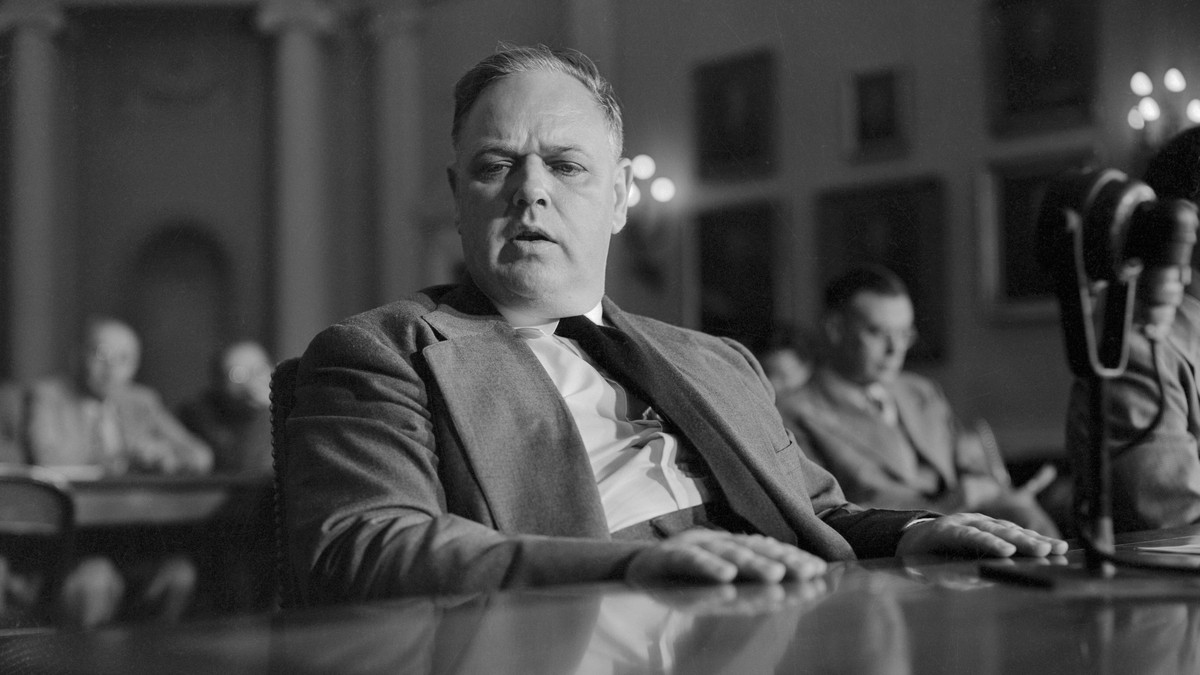
Playwright David Mamet recently acknowledged that he had been profoundly influenced by Communist apostate Whittaker Chambers’s 1952 anti-Communist memoir, Witness. Mamet described
how reading Chambers’s opus inspired “the wrenching experience” of
forcibly reevaluating the way he thought, particularly his confessed
leftist-herd co-dependence. Also, echoing the delusive herd mentality of
the Left’s ad hominem attacks
in the 1950s on Chambers — whose allegations of Communist conspiracies
have been entirely vindicated with irrefragable documentation from the
captured Soviet Venona cables — Congressman Peter King’s staid initial hearings of March 10, 2011, on American Muslim radicalization engendered similarly apoplectic, and equally unwarranted condemnation, even before getting underway.
Mamet’s invocation of Witness, and the repeated hysterical, if groundless, objections to the second round
of hearings by Representative King’s Homeland Security Committee (June
15, 2011, on Muslim radicalization in U.S. prisons), are fitting
reminders that today marks the 50th anniversary of Whittaker Chambers’s
death.
Chambers was born April 1, 1901, in Philadelphia, and spent his
childhood on the south shore of Long Island, in (then rural) Lynbrook.
Upon graduating high school, Chambers left home and worked as a
construction laborer on the Washington, D.C., subway system, before
drifting to New Orleans, and then returning to attend Columbia
University from 1920 to 1924. Under the tutelage of Columbia English
professor Mark Van Doren (before Van Doren became an internationally
known literary critic and poet), Chambers tried his hand at poetry, even
completing a book of poems entitled “Defeat in the Village,” before
realizing, “I never could write poetry good enough to be worth writing.”
This apprenticeship, however, helped teach Chambers “the difficult,
humbling, exacting art of writing,” and he would go on to become an
exceptionally gifted writer of prose. He joined the Communist party in
1925, experiencing great success as a writer at the Daily Worker and as an editor at The New Masses,
both Communist-controlled publications. In 1932, Chambers was asked to
join the underground movement of the Communist party, and he served in
the Fourth Section of Soviet Military Intelligence. Recognizing
Chambers’s intellectual prowess, the underground placed him with the
Ware Group (a collection of Communist cells consisting of government
officials and journalists) in Washington, D.C. It was here, among other
promising New Deal civil servants, that he encountered Alger Hiss.
Chambers and Hiss, along with their spouses, became close friends.
During late 1938, overwhelmed by the horrific actions of the Soviet
Communist party, in particular the Stalinist purges and forced
starvation of Ukrainian peasants, and having rejected Communism’s
militant atheism, Chambers left the Communist movement. The Nazi-Soviet
Pact of 1939 was a watershed event for Chambers, who realized that much
of the confidential information about the U.S. that he had forwarded to
the Soviet Union could now be passed to Germany. Thus Chambers decided
to divulge his prior activities for the Communist underground to the
federal government. Shortly thereafter, Chambers was able to meet with
the head of security at the State Department, A. A. Berle. Although
Chambers revealed most of his activities, he withheld the facts of
espionage conducted by his cell, largely to protect others, including,
notably, Alger Hiss. Regardless, it was not until 1948 — nine years
later — that the information he provided to Berle was acted upon by the
government. Chambers was subpoenaed by the House Committee on
Un-American Activities (HUAC) to corroborate the testimony of Elizabeth
Bentley — the so-called “blonde spy queen” — who alleged that Soviet
espionage was occurring within the U.S. government. Chambers
corroborated Bentley’s allegations, supplemented them with his own, and
confronted Alger Hiss on the first day of his testimony. (Eventually,
all 21 names that Chambers provided to HUAC were confirmed by subsequent
Soviet archival research.) In 1950, Hiss was convicted of perjury after
two federal trials.
A naturally gifted linguist, particularly fluent in German, Whittaker Chambers translated into English Bambi, Dunant: the Story of the Red Cross, and a number of children’s books over the years. Chambers joined Time magazine in 1939, initially as a book reviewer, later as a writer and editor. He wrote many of Time’s
cover stories during his tenure, including profiles of historian Arnold
Toynbee, vocalist Marian Anderson, theologian Reinhold Niebuhr, and
Pope Pius XII. Chambers, based upon his experience as a Communist and
intuitive grasp of history, displayed a remarkably prescient
understanding of the Cold War as an editor and writer for Time’s foreign-news section. He also contributed seven brilliant essays to Life’s 1947–1948 “Picture History of Western Civilization” series. Compelled to resign from Time during the tumultuous Hiss trials, Chambers became an editor and writer on the staff of National Review
from the latter part of 1957 to the middle of 1959. Throughout most of
his journalistic career, Chambers continued to operate a farm in
Westminster, Md., maintaining a dairy herd, raising sheep and beef
cattle, and producing various crops.
A great deal can be gleaned
from Chambers’s witness-martyrdom in the struggle against Communism —
he sacrificed himself “a little in advance to try to win for you that
infinitesimal slightly better chance” — and applied to the modern threat
of resurgent Islamic totalitarianism. First, Chambers’s own brief 1947
comparison of Communism and nascent Islam should be seen in the context
of more extensive, independent characterizations by Western scholars
and intellectuals who also juxtaposed these ideological systems. Three
other logical connections can be made:
● Chambers’s searing critique of Communism, and his related criticism of the West’s embrace of godless secular humanism.
● Chambers’s understanding
that faith in the Judeo-Christian God was conjoined to Biblical
freedom, a concept that was antithetical to the conception of modern
atheistic totalitarianism epitomized by Communism — and to the Islamic doctrine regarding “hurriyya,” which, while “hurriya” is Arabic for “freedom,” refers to submission to the will of Allah.
● Chambers’s apostasy from Communism — and the shared insights of contemporary apostates from Islam.
From the time of Chambers’s break with the Communist party in late
1938, till his death nearly 23 years later, Chambers was consumed by the
West’s abnegation of its own institutions — which had been rooted for
two millennia in a belief in the Judeo-Christian God — and their
threatened active destruction by the votaries of mass secular
totalitarian movements, notably Fascism and Communism. His December,
1947, Time book review of Rebecca West’s The Meaning of Treason, a series of penetrating reports on the trials of British World War II traitors, opens with these observations:
When, in 1936, General Emilio Mola announced that he would capture
Madrid because he had four columns outside the city and a fifth column
of sympathizers within, the world pounced on the phrase with the
eagerness of a man who has been groping for an important word. The world
might better have been stunned as by a tocsin of calamity. For what
Mola had done was to indicate the dimension of treason in our time.
Other ages have had their individual traitors — men who from
faintheartedness or hope of gain sold out their causes. But in the 20th
century, for the first time, men banded together by millions, in
movements like fascism and communism, dedicated to the purpose of
betraying the institutions they lived under. In the 20th century,
treason became a vocation whose modern form was specifically the treason
of ideas.
Modern man was challenged to choose between the traditions of a
2,000-year-old Christian civilization and the new totalitarian systems
which, in the name of social progress, contended for the allegiance of
man’s secular mind. The promise of the new ideas was as old as that
serpentine whisper heard in the dawn of the Creation: “You shall become
as gods” — for the first traitor was the first man.
The case of Alan Nunn May represented for Rebecca West the bottom of
what Chambers characterizes as “a descent into the circles of a drab
inferno.” May, a lecturer on physics at the University of London, was a
longstanding Communist-party member. Ostensibly volunteering to serve
his country, he became the senior member of the British atomic-bomb
project’s nuclear-physics division during World War II. May then
transferred to Russia samples of uranium 233 and enriched uranium 235.
Chambers’s review of The Meaning of Treason also compared the
violent fanaticism of the 20th century’s secular totalitarian systems’
adherents to the votaries of Islam. The modern totalitarians expressed
“new ideas” that were “violently avowed,” and “the hallmark of their
advocates was a fanaticism unknown since the first flush of Islam.”
Chambers’s passing comparison does in fact have doctrinal and historical validity, and comports with other serious modern assessments.
For example, Bernard Lewis, the doyen of living Western Islamic
scholars, in his 1954 essay “Communism and Islam,” expounded upon on the
quintessence of totalitarian Islam, and how it was antithetical in
nature to Western democracy, while sharing important features of
Communist totalitarianism — most notably, global domination via jihad:
Both groups profess a totalitarian doctrine, with complete and final
answers to all questions on heaven and earth; the answers are different
in every respect, alike only in their finality and completeness, and in
the contrast they offer with the eternal questioning of Western
man. . . . The humorist who summed up the Communist
creed as “There is no God and Karl Marx is his Prophet” was laying his
finger on a real affinity. The call to a Communist Jihad, a Holy War for
the faith — a new faith, but against the self-same Western Christian
enemy — might well strike a responsive note.
Moreover, had he turned his formal gaze on the subject, Chambers would
never have accepted the “Abrahamic faiths” canard, because he would have
seen the unbridgeable chasm that separates Allah the autocrat’s “Pantheism of Force” from the Judeo-Christian God of Biblical freedom.
While all ex-Communists would agree they renounced Communism to be free, for Chambers, freedom itself is a manifestation of divinity:
Freedom is a need of the soul, and nothing else. It is in striving
toward God that the soul strives continually after a condition of
freedom. God alone is the inciter and guarantor of freedom. He is the
only guarantor. External freedom is only an aspect of interior freedom.
Political freedom, as the Western world has known it, is only a
political reading of the Bible. Religion and freedom are indivisible.
Without freedom the soul dies. Without the soul there is no
justification for freedom.
Hurriyya and the uniquely Western concept of freedom are completely at
odds, hurriyya — as Ibn Arabi (d. 1240), the lionized “Greatest Sufi
Master,” expressed it — “being perfect slavery.” And this conception is
not merely confined to the Sufis’ metaphorical understanding of the
relationship between Allah the “master” and his human “slaves.”
The late American scholar of Islam Franz Rosenthal (d. 2003) analyzed
the larger context of hurriyya in Muslim society. He notes the
historical absence of hurriyya as “a fundamental political concept that
could have served as a rallying cry for great causes.” An individual
Muslim “was expected to consider subordination of his own freedom to the
beliefs, morality and customs of the group as the only proper course of
behavior.”Thus, politically, Rosenthal concludes, “the individual was
not expected to exercise any free choice as to how he wished to be
governed. . . . In
general . . . governmental authority admitted of no
participation of the individual as such, who therefore did not possess
any real freedom vis-a-vis it.”
Chambers, in short, would have recognized the implications of the
yawning gap between Allah’s “hurriyya” and Western freedom as a
manifestation of the Judeo-Christian God, expressed so eloquently by
James Freeman Clarke (d. 1888), America’s first, and arguably still one
of her greatest, scholars of comparative religion. Comparing Islam to
Judaism, Clarke observed,
Goodness does not consist in obedience to divine will, but in
conformity to the divine character. This is the doctrine of the Old
Testament and one of its noblest
characteristics. . . . Mohammedanism is a relapse
[from Judaism] . . . for it makes God only an
arbitrary sovereign whose will is to be obeyed without any reference to
its moral character.
Moreover, Clarke noted,
Islam’s Allah was“abstracted from matter, and so not to be represented
by pictures and images; God withdrawn out of the world, and above all —
in total separation.” In contrast, Judaism conceptualized
God as being “with man, by his repeated miraculous coming down in
prophets, judges, kings; also with his people, the Jews, mysteriously
present in their tabernacle and temple.”
Christianity, Clarke maintained, added the notion of the God “in us all,” a strong pantheistic tendency:
The New Testament is full of this kind of pantheism, — God in man, as
well as God with man. Jesus made the step forward from God with man to
God in man, — “I in them, thou in me.” The doctrine of the Holy Spirit
is this idea, of God who is not only will and power, not only wisdom and
law, but also love; of a God who desires communion and intercourse with
his children, so coming and dwelling in them. Mohammed teaches a God
above us; Moses teaches a God above us, and yet with us; Jesus teaches
God above us, God with us, and God in us.
This is likely derived from the converted Greeks and Romans, and distinctly evident in Whittaker Chambers’s theology. Clarke concluded
that Islam’s alternative “central idea concerning God” — its conception
of Allah — has not been salutary for Muslim societies: “Its governments
are not governments. . . . It makes life barren and
empty. It encourages a savage pride and cruelty. It makes men tyrants
or slaves, women puppets, religion the submission to an infinite
despotism.”
While Chambers’s defense of the West hinged on deep religious faith, he
respected, within severe limits, the Enlightenment legacy of reason,
particularly its role in shaping American freedom. Conversely, the
scholar Ibn Warraq, contemporary apostate from Islam, although
profoundly skeptical of “revelation,” pays homage to Judeo-Christian
religious ethics (from the forthcoming Why the West is Best):
Judeo-Christianity introduced the ethical concepts of love,
compassion, and forgiveness, expressing a new sensibility, a new
responsiveness to human suffering, and a refusal to accept the normalcy
of evil. Jesus’ Sermon on the Mount [Matt. 5-7] exhorts each person to
take responsibility and assume all consequences for human suffering,
even though he is not the original cause. Christian love demands each
individual to go the extra mile for the neighbor, a timely reminder that
we are responsible for bearing the cares of the world, that we have a
debt to acquit, and must act accordingly to fight evil on behalf of all
humans for as long as suffering exists. Our humanity lies in our
responsibility for others.
Whittaker Chambers’s ex-Communist colleague Arthur Koestler famously told Richard Crossman, editor of The God That Failed,
an anthology of essays written by apostates from Communism, “You hate
our Cassandra cries, and resent us as allies — but, when all is said, we
ex-Communists are the only people on your side who know what it is all
about.”
Crossman added this germane observation to the anthology’s introduction, after studying the diverse experiences of the ex-Communist contributors:
Silone [Ignacio Silone, author and former head the Italian Communist
Party underground] was joking when he said to Togliatti [a close friend
of Silone, and former secretary of the Italian Communist Party] that the
final battle would be between the Communists and ex-Communists.. But no
one who has not wrestled with Communism as a philosophy and Communists
as political opponents can really understand the values of Western
democracy. The Devil once lived in Heaven, and those who have not met
him are unlikely to recognize an angel when they see one.
Ibn Warraq synthesized and updated these observations to highlight
their urgent relevance to Islam’s resurgent modern jihad against the
West. Barring the very dubious prospect that “a reformed, tolerant,
liberal kind of Islam” emerges imminently, he warned,
Perhaps the final battle will be between Islam and Western democracy.
And these former Muslims, to echo Koestler’s words, on the side of
Western democracy are the only one’s who know what it’s all about, and
we would do well to listen to their Cassandra cries.
We ignore Warraq’s plea — repeated by legions of Muslim apostates — at our existential peril.
Chambers’s pellucid formulation of the Communist threat was rooted in
his thorough doctrinal and experiential understanding of Communism:
No one knows so well as the ex-Communist the character of the
conflict, and of the enemy . . . For no other has
seen so deeply into the total nature of the evil with which Communism
threatens mankind.
The failure to understand that fact is part of the total failure of
the West to grasp the nature of its enemy, what he wants, what he means
to do and how he will go about doing it. It is part of the failure of
the West to understand that it is at grips with an enemy having no moral
viewpoint in common with itself, that two irreconcilable viewpoints and
standards of judgment, two irreconcilable moralities, proceeding from
two irreconcilable readings of man’s fate and future are involved, and
hence their conflict is irrepressible.
His tocsin of looming calamity helped arouse the West from its complacent ignorance regarding the Communist threat.
Let us pray that we rapidly overcome our generation’s similar complacent ignorance about the threat of totalitarian Islam.
— Andrew Bostom is the author of The Legacy of Jihad and The Legacy of Islamic Antisemitism. This piece is adapted from the essay “Whittaker Chambers, Communism, and Islam.”